Thomas Paine Chance to Start the World Again
Counselor: Robert A. Ferguson, George Edward Woodberry Professor in Police force, Literature and Criticism, Columbia University, National Humanities Centre Fellow.
Copyright National Humanities Centre, 2014
How did Thomas Paine's pamphlet Common Sense convince reluctant Americans to carelessness the goal of reconciliation with Britain and have that separation from Great britain — independence — was the only pick for preserving their liberty?
Understanding
By January 1776, the American colonies were in open rebellion confronting Britain. Their soldiers had captured Fort Ticonderoga, besieged Boston, fortified New York Urban center, and invaded Canada. All the same few dared voice what most knew was true — they were no longer fighting for their rights every bit British subjects. They weren't fighting for self-defense, or protection of their belongings, or to strength Britain to the negotiating table. They were fighting for independence. Information technology took a hard jolt to motion Americans from professed loyalty to alleged rebellion, and information technology came in large part from Thomas Paine'southward Mutual Sense. Not a dumbed-down rant for the masses, equally oftentimes described, Common Sense is a masterful piece of statement and rhetoric that proved the power of words.
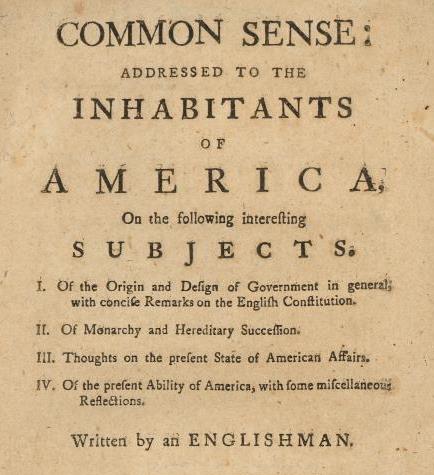
Text
Thomas Paine, Mutual Sense, 1776 
[Discover more primary sources related to Common Sense in Making the Revolution from the National Humanities Eye.]
Text Type
Literary nonfiction; persuasive essay. In the Text Analysis section, Tier ii vocabulary words are defined in pop-ups, and Tier 3 words are explained in brackets.
Text Complexity
Grades 9-10 complexity ring.
For more than information on text complexity encounter these resources from achievethecore.org.
Click here for standards and skills for this lesson.
X
Mutual Core State Standards
- ELA-Literacy.RI.ix-x.6 (Determine an author's point of view or purpose in a text and analyze how an author uses rhetoric to advance that betoken of view or purpose.)
Advanced Placement US History
- 3.2 (IB) (Republican forms of government found expression in Thomas Paine's Mutual Sense.)
Avant-garde Placement English language and Limerick
- Reading nonfiction
- Analyzing and identifying and author's apply of rhetorical strategies
Teacher's Note
This lesson focuses on the sections central to Paine's argument in Mutual Sense — Section III and the Appendix to the Third Edition, published a month after the first edition. We exercise not recommend assigning the full essay (Sections I, II, and Iv require avant-garde background in British history that Paine'south readers would have known well). All the same, students should be led through an overview of the essay to understand how Paine built his arguments to a "self-axiomatic" conclusion (See Groundwork: Bulletin, below.)
Atomic number 82 students through an initial overview of the essay (come across Background). To brainstorm, they could skim the full text and read the pull-quotes (separated quotes in large bold text). What impression of Common Sense do the quotes provide? What questions practise they prompt? And so guide students as they read (possibly aloud) Department III of Common Sense and the Appendix to the Tertiary Edition (pp. 10-19 and 25-29 in the full text provided with this lesson).
Continue to the close reading of three excerpts in the Text Assay below. (Note that part of Excerpt #3 is a Common Core exemplar text.)
This lesson is divided into two parts, both attainable below. The teacher'southward guide includes a groundwork note, the text analysis with responses to the shut reading questions, access to the interactive exercises, and a follow-upwardly assignment. The pupil's version, an interactive worksheet that tin be east-mailed, contains all of the above except the responses to the close reading questions.
Teacher's Guide (continues below)
| Educatee Version (click to open)
|
Teacher's Guide
Background

The homo at correct does not look angry. To us, he projects the typical figure of a "Founding Father" — composed, elite, and empowered. And to united states of america his famous essays are awash in powdered-wig prose. But the portrait and the prose confute the reality. Thomas Paine was a firebrand, and his most influential essay — Common Sense — was a fevered no-holds-barred phone call for independence. He is credited with turning the tide of public opinion at a crucial juncture, convincing many Americans that war for independence was the simply choice to accept, and they had to take information technology now, or else.
Common Sense appeared as a pamphlet for sale in Philadelphia on January 10, 1776, and, as we say today, it went viral. The starting time printing sold out in two weeks and over 150,000 copies were sold throughout America and Europe. It is estimated that one fifth of Americans read the pamphlet or heard information technology read aloud in public. General Washington ordered it read to his troops. Within weeks, it seemed, reconciliation with Britain had gone from an honorable goal to a cowardly betrayal, while independence became the rallying cry of united Patriots. How did Paine achieve this?
1. Timing.

Over a year elapsed betwixt the outbreak of armed disharmonize and the Declaration of Independence. During these fifteen months, many bemoaned the reluctance of Americans to renounce their ties with Britain despite the escalating warfare around them. "When we are no longer fascinated with the Idea of a speedy Reconciliation," wrote Benjamin Franklin in mid-1775, "we shall exert ourselves to some purpose. Till so Things will exist done past Halves."1 In addition, in that location remained much discord among the colonies well-nigh their shared future. "Some timid minds are terrified at the word independence," wrote Elbridge Gerry in March 1776, referring to the colonial legislatures. "America has gone such lengths she cannot recede, and I am convinced a few weeks or months at furthest will convince her of the fact, merely the fruit must have fourth dimension to ripen in some of the other Colonies."2 In this surroundings, Common Sense appeared like a "falling star," wrote John Adams,three and propelled many to support independence. Many noted it at the fourth dimension with anaesthesia.
"Sometime past the idea [of independence] would have struck me with horror. I now see no alternative;… Can any virtuous and brave American hesitate ane moment in the choice?"
The Pennsylvania Evening Post, 13 February 1776
"We were blind, merely on reading these enlightening works the scales have fallen from our eyes…. The doctrine of Independence hath been in times past greatly disgustful; we abhorred the principle. Information technology is now become our delightful theme and commands our purest angel. We revere the author and highly prize and admire his works."
The New-London [Connecticut] Gazette, 22 March 1776
ii. Bulletin.
What made Mutual Sense and so esteemed and "enlightening"? Some contend that Common Sense said cypher new, that it simply put the phone call-to-war in fiery street linguistic communication that rallied the common people. Only this trivializes Paine's accomplishment. He did have a new message in Common Sense — an ultimatum. Surrender reconciliation at present, or forever lose the gamble for independence. If we neglect to act, we're self-deceiving cowards condemning our children to tyranny and adulterous the globe of a beacon of liberty. It is our calling to model cocky-actualized nationhood for the world. "The cause of America is in a groovy measure the crusade of all mankind."

Paine divided Common Sense into 4 sections with deceptively mundane titles, mimicking the erudite political pamphlets of the day. Just his essay did non offer the same-sometime-same-old treatise on British heritage and American rights. Hither's what he says in Mutual Sense:
Introduction: The ideas I present here are so new that many people will decline them. Readers must articulate their minds of long-held notions, apply common sense, and prefer the crusade of America every bit the "cause of all mankind." How nosotros reply to tyranny today volition matter for all time.
Section One: The English government you worship? It'south a sham. Man may demand authorities to protect him from his flawed nature, but that doesn't mean he must suffocate under fauna tyranny. Just as you would cut ties with abusive parents, you must interruption from Britain.
Section Two: The monarchy you revere? It'southward not our protector; it's our enemy. It doesn't care nearly us; information technology cares nearly Uk's wealth. It has brought misery to people all over the earth. And the very thought of monarchy is absurd. Why should someone dominion over u.s. simply because he (or she) is someone's child? So evil is monarchy by its very nature that God condemns it in the Bible.
Department Three: Our crisis today? It'due south folly to think we should maintain loyalty to a distant tyrant. It's cocky-demolition to pursue reconciliation. For us, right hither, right now, reconciliation ways ruin. America must separate from Britain. We can't go dorsum to the cozy days before the Postage stamp Act. You know that's true; information technology's time to admit it. For heaven's sake, nosotros're already at state of war!
Department 4: Can we win this war? Absolutely! Ignore the naysayers who tremble at the thought of British might. Let'due south build a Continental Navy as we have built our Continental Army. Let us declare independence. If we delay, it will be that much harder to win. I know the prospect is daunting, but the prospect of inaction is terrifying.
A month later, in his appendix to the third edition, Paine escalated his appeal to a utopian fervor. "Nosotros have it in our power to begin the world again," he insisted. "The altogether of a new earth is at mitt."
three. Rhetoric.
"It is necessary to be bold," wrote Paine years afterward on his rhetorical power. "Some people tin can exist reasoned into sense, and others must be shocked into it. Say a bold matter that volition stagger them, and they volition begin to recollect."4 Go along this idea front end and center as you lot study Common Sense.
As an experienced essayist and a contempo English immigrant with his ain deep resentments against Uk, Paine was the right man at the right time to galvanize public opinion. He "understood amend than anyone else in America," explains literary scholar Robert Ferguson, "that 'style and manner of thinking' might dictate the difficult shift from loyalty to rebellion."5 Earlier Paine, the language of political essays had been moderate. Educated men wrote civilly for publication and kept their fury for private letters and diaries. Then came Paine, cursing Britain as an "open enemy," denouncing George Three equally the "Royal Animal of England," and damning reconciliation as "truly farcical" and "a beguiling dream." To think otherwise, he charged, was "absurd," "unmanly," and "repugnant to reason." Every bit Virginian Landon Carter wrote in dismay, Paine unsaid that anyone who disagreed with him "is cypher short of a coward and a sycophant [stooge/lackey], which in patently meaning must be a damned rascal."half-dozen Paine knew what he was doing: the pen was his weapon, and words his ammunition. He argued with ideas while convincing with raw emotion. "The bespeak to remember," writes Ferguson, "is that Paine'due south natural and intended audience is the American mob…. He uses anger, the natural emotion of the mob, to let the well-nigh active groups find themselves in the general volition of a republican citizenry."7 What if Paine had written the Declaration of Independence with the aforementioned hard-driving rhetoric?
AS JEFFERSON WROTE Information technology: We hold these truths to be self-evident, that all men are created equal, that they are endowed by their Creator with certain unalienable Rights, that amongst these are Life, Freedom and the pursuit of Happiness. — That to secure these rights, Governments are instituted among Men, deriving their just powers from the consent of the governed, — That whenever any Course of Government becomes subversive of these ends, it is the Right of the People to alter or to abolish it, and to institute new Government, laying its foundation on such principles and organizing its powers in such form, as to them shall seem near probable to effect their Safe and Happiness.
IF PAINE HAD WRITTEN Information technology: NO homo tin deny, without abandoning his God-given ability to reason, that all men enter into existence every bit equals. No matter how lowly or majestic their origins, they enter life with three God-given RIGHTS — the correct to alive, to right to live free, and the right to live happily (or, at the to the lowest degree, to pursue Happiness on world). Who would choose beingness on any other terms? So treasured are these rights that man created government to protect them. So treasured are they that human is duty-bound to destroy any government that crushes them — and kickoff afresh as men worthy of the title of FREE MEN. This is the plainly truth, impossible to refute.
Text Analysis
Excerpt #1
Close Reading Questions
Imagine yourself sitting downward to read Mutual Sense in Jan 1776. How does Paine innovate his reasoning to you?
He announces that his logic volition be straight and downward to earth, using merely "uncomplicated facts" and "plain arguments" to explain his position, different (he implies) the complex political pamphlets addressed to the educated elite. His audience would understand "common sense" to propose the moral sense of the yeoman farmer, whose independence and articulate-headedness made him a more reliable guardian of national virtue (similar to Jefferson'south agrestal ideal).
Why does he write "I offer nothing more" instead of "I offer you many reasons" or "I offer a detailed argument"?
"Nothing more than" implies that Common Sense volition be easy to follow, presenting only what is necessary to make his statement. (Paine considered titling his essay Plain Truth.)
How does Paine enquire y'all to set yourself for his "common sense" arguments?
Be willing to put aside pre-conceived notions, he says, and judge his arguments on their ain merits.
What does he imply by proverb a off-white reader "volition put on, or rather than he will not put off, the true character of a human being"?
He implies that any reader who would turn down to consider his arguments is narrow-minded. With the "on"–"off" dissimilarity, he suggests that yous, the individual reader, are open up-minded and thus a young man man of honor willing to consider a new signal of view.
In the following pages I offering nothing more than simple facts, plain arguments, and mutual sense: and have no other preliminaries to settle with the reader than that he will divest [rid] himself of prejudice and prepossession, and suffer [permit] his reason and his feelings to determine for themselves: that he volition put on, or rather that he will not put off, the truthful grapheme of a man, and generously enlarge his views beyond the nowadays day.
PARAGRAPH 55
This paragraph begins with one of the virtually famous hyperboles in American writing. A hyperbole is an overstatement or exaggeration to emphasize a betoken. What are the 2 examples of hyperbole in this paragraph?
1. "the lord's day never shined on a cause of greater worth"
ii. "posterity… volition be more or less affected, even to the terminate of time"
With the hyperboles, how does Paine lead y'all to view the "cause" of American independence?
View it, he says, from an overarching global perspective, not the narrow perspective of American colonists in the belatedly 1700s. The hyperboles are ultimates — the most worthy of worthy causes, affecting the futurity at present and forever. The American cause can lead mankind toward enlightened self-decision, driving frontward the progress of civilisation. Paine says this directly in his introduction: "The cause of America is in a bully measure out the cause of all mankind." We're not just talking taxes and representation, people.
What tone does Paine add with the phrases "The sun never shined" and "even to the end of time"?
A biblical and prophetic tone. The sun shining down on man endeavors suggests divine endorsement of the American crusade — a cause that will bring light and freedom ("salvation") to the world. Resisting the crusade, Paine implies, would be resisting divine will.
Let's consider Paine as a wordsmith. How does he use repetition to add impact to the first part of the paragraph?
He includes 2 repetitive sets:
one. "'Tis not" to begin sentences ii and three [anaphora]
2. the phrases "of a city, a country, a province, or a kingdom" and "of a day, a year, or an age" [prepositions with multiple objects].
Read the section aloud to hear the insistent rhythm that elevates Paine'southward prose to a rousing phone call to action (his goal in writing Common Sense).
Paine ends this paragraph with an analogy: What nosotros practise now is similar carving initials into the bark of a immature oak tree. What does he mean with the illustration?
A. This is the time to create a new nation. Our smallest efforts at present will lead to enormous benefits in the future.
B. This is the fourth dimension to unite for independence. Discord among usa now will escalate into future crises that could ruin the young nation.
Respond: B.
The sun never shined on a cause of greater worth. 'Tis non the affair of a city, a country, a province, or a kingdom, but of a continent – of at least ane eighth role of the habitable globe. 'Tis not the concern of a day, a twelvemonth, or an age; posterity are virtually involved in the contest and will exist more than or less affected, even to the terminate of fourth dimension, past the proceedings now. Now is the seed time of continental [colonies'] union, organized religion and award. The least fracture now will be similar a proper noun engraved with the point of a pin on the tender rind of a immature oak; the wound will enlarge with the tree, and posterity read information technology in full grown characters.
PARAGRAPH 58
Paine includes multiple repetitions in this paragraph. What word repetition do you notice?
The adjective "new" in a "new area" and a "new method." [anaphora]
What audio repetitions do you find?
Alliteration: argument/arms/area/arisen
plans/proposals/prior/April
Consonance: politics/struck
method/thursdayinking/hathursday
1000atter/argument/archiliads
Read the sentences aloud. What impact does the repetition add to Paine's delivery?
A stirring oratorical rhythm is accomplished, like that of a solemn voice communication or sermon meant to convey the truth and gravity of an argument.
Paine compares the attempts to reconcile with Britain subsequently the Battle of Lexington and Concord to an old annual. What does he hateful?
He means the idea of reconciliation is now preposterous and that no rational person could back up it. No one would use last twelvemonth'south almanac to make plans for the electric current year! As well, as an almanac ceases to be useful at a specific moment (midnight of December 31), Paine implies that reconciliation ceased to be a valid goal at the moment of the first shot on April 19, 1775. (Paine often alludes to aspects of colonial life, like almanacs, that would resonate with all readers. They include references to farming, tree cutting, hunting, state buying, slavery, biblical scripture, family and neighbor bonds, maturation, and the parent-child relationship; see "The Metaphor of Youth" below.)
Past referring the matter from argument to arms, a new area for politics is struck; a new method of thinking hath arisen. All plans, proposals, etc., prior to the nineteenth of April, i.e., to the commencement of hostilities [Lexington and Hold], are similar the almanacs of the terminal year which, though proper [authentic] then, are superseded and useless now. Whatever was advanced by the advocates on either side of the question then, terminated in one and the same point, viz. [that is], a marriage with Great U.k.. The only divergence between the parties was the method of effecting it — the one proposing force, the other friendship; but it hath so far happened that the start hath failed and the 2nd hath withdrawn her influence.
PARAGRAPH 59
Paine compares the goal of reconciliation to an "agreeable dream [that has] passed abroad and left united states of america as we were." Why doesn't he aim harsher criticism here at the goal of reconciling with United kingdom?
With this paragraph, Paine begins his argument confronting reconciliation and does not desire to insult or amerce his readers at the kickoff. Everyone can hope, he implies: there'south nix wrong with that, but we accept to motility on if a hope proves fruitless.
With this in listen, what tone does he lead the reader to expect: cynical, impatient, hopeful, reasonable, impassioned, angry?
Reasonable. The two sentences resemble the opening of a legal argument that promises a balanced appraisal of ii options on the basis of known evidence ("principles of nature") and honest ordinary reasoning ("common sense").
How does his tone set the resistant reader?
Paine means to deflect challenges of bias or extremism by inviting readers to give him a hearing. "If I'm being fair in my writing, yous can endeavor to be fair in your listening."
While Paine promises a off-white appraisement, look how he describes the two options in the concluding judgement.
Selection ane: "if separated" from Britain
Option two: "if dependent on U.k."
Why didn't he employ the usual terms for the 2 options — "independence" and "reconciliation"?
First, INDEPENDENCE and RECONCILIATION sound similar every bit plausible options, but Paine wants to convince you that independence is the only adequate choice. If so, and then why did he choose SEPARATION instead of INDEPENDENCE? By Jan 1776, INDEPENDENCE carried the drastic connotations of war and treason. It was an irrevocable decision with unknown consequences. In contrast, SEPARATION seems less drastic, and even positive. In human development, separation from one's parents is the natural and long-sought step to full adulthood. That'south the self-epitome Paine wants to foster in his readers. Are we adults or children? [See the activity below, "The Metaphor of Youth".]
In this vein, Paine chose DEPENDENCE instead of RECONCILIATION for Pick ii (staying with Britain). RECONCILIATION suggests the calm and rational understanding of 2 grownups, only Paine wants you to view reconciliation as the defeatist selection of spineless subjects who could never have care of themselves. In other words, DEPENDENCE.
[Note: Paine does call the two options "independence" and "reconciliation" elsewhere in Common Sense, simply he meant to avoid them hither.]
Equally much hath been said of the advantages of reconciliation, which, like an agreeable dream, hath passed abroad and left us as nosotros were, it is but right that we should examine the contrary [opposing] side of the statement and inquire into some of the many fabric injuries which these colonies sustain, and always will sustain, past being connected with and dependent on Great U.k.. To examine that connection and dependence, on the principles of nature and mutual sense, to see what nosotros have to trust to [expect] if separated, and what nosotros are to expect if dependent.
PARAGRAPH 60
 Activity: The Metaphor of Youth
Study Paine'southward metaphors that compare the colonies' readiness for independence to a child's maturation into adulthood.
Here Paine rebuts the first argument for reconciliation—that America has thrived as a British colony and would fail on her own. How does he dismiss this statement?
He slams it down hard. "Aught tin be more Beguiling," he yells. The argument is across misdirected or brusk-sighted, he insists; it's a fatal fault in reasoning. And then much for calm and reasoned contend. Just Paine is non having a temper tantrum in impress. His technique was to argue with ideas while convincing with emotion.
Paine follows his utter rejection of the argument with an illustration. Complete the analogy: America staying with Britain would be like a child _______.
"America staying with Uk would be like a kid remaining dependent on its parents forever and never growing upwards." And who would want that, Paine implies? By writing "first twenty years of our lives" instead of, say, "start v years," Paine alludes to the general consensus that a twenty-year-erstwhile is an adult.
Paine goes ane pace farther in the last judgement. What does he say about America'due south "babyhood" as a British colony?
He "answers roundly" (with conviction) that the colonies' growth was really hampered past being part of a European empire. They would have been more than healthy and successful "adults," he insists, if they had not been the "children" of the British empire. This was a radical premise in 1776, but 1 that buttressed Paine's statement for independence
I have heard information technology asserted by some that as America hath flourished nether her old connection with Great U.k., that the aforementioned connection is necessary towards her future happiness, and will always take the same effect. Cypher can be more fallacious than this kind of statement. We may also assert that because a child has thrived upon milk, that it is never to have meat, or that the first 20 years of our lives is to go a precedent for the adjacent 20. Merely even this is albeit more than is truthful; for I answer roundly that America would have flourished equally much, and probably much more, had no European power had anything to do with her.
PARAGRAPH 61
Excerpt #2
Close Reading Questions
Hither Paine challenges his opponents to bring "reconciliation to the touchstone of nature." What does he mean? (A "touchstone" is a test of the quality or genuineness of something. From aboriginal times the purity of gold or silver was tested with a "touchstone" of basalt stone.)
Exam the chances of reconciliation confronting what you know about people's reactions in similar crises throughout history, non against your own hopes and fears during this particular crisis. In other words, use common sense.
At the commencement of this paragraph Paine mildly faults the supporters of reconciliation as unrealistic optimists "still hoping for the all-time." By the end of the paragraph, still, they are cowards willing to "shake hands with the murderers." How did he construct the paragraph to accomplish this transition?
He poses two challenges to the supporters of reconciliation. If they can honestly respond each challenge, he asserts, and still back up reconciliation, then they are selfish cowards bringing ruin to America.
Paraphrase the first challenge (sentences two–5).
"Enquire yourself if you can remain loyal to a nation that has brought war and suffering to you. If yous say you can, you're fooling yourself and condemning us to a worse life under United kingdom of great britain and northern ireland than we suffer now."
Paraphrase the 2d challenge (sentences half dozen–xi).
"Have you lot been the victim of British violence? If you lot haven't, then you withal owe compassion to those who have. And if you have, nonetheless still support reconciliation, then you lot take abandoned your conscience."
With what phrase does Paine condemn those who would nonetheless promise for reconciliation even if they were victims of British violence?
They are men who "tin can even so shake easily with the murderers," i.e., men who have betrayed their fellow Americans and thus go as evil every bit the British invaders. There is no dash in this condemnation, and thus no way for the reader to avert its implications.
Annotation how Paine weaves impassioned questions through the paragraph: "Are you simply deceiving yourselves?" "Take you lost a parent or a child past their hands?" How do these questions intensify his challenges?
Addressed to "you" directly and not a faceless "he or they," the questions deliver an in-your-face challenge that allows no escape. Here's my question to you lot: Answer it! or your silence will reveal your cowardice.
Rewrite sentences #4 and #11 to change the 2nd-person "you" to the third-person "he/she/they." How does the alter weaken Paine's challenges?
The reader is off the hook. Since the challenges are deflected from "you," the reader, to the third-person "other," no firsthand personal reply is demanded. The reader can blithely read on and avert the aim of Paine's questions.
 Worksheet: The Question as a Rhetorical Device
Use this worksheet to examine Paine's use of questions every bit persuasive devices throughout Common Sense, specifically the rhetorical question and the hypophora (questions with unsaid or stated answers, used for rhetorical impact).
Men of passive tempers [temperaments] wait somewhat lightly over the offenses of Uk and, nonetheless hoping for the all-time, are apt to call out, "Come up, come, we shall be friends again for all this." Simply examine the passions and feelings of mankind. Bring the doctrine of reconciliation to the touchstone of nature and so tell me whether y'all tin can hereafter love, honor, and faithfully serve the power that hath carried fire and sword into your state? If you cannot do all these, and then are you lot only deceiving yourselves and by your delay bringing ruin upon posterity? Your future connection with United kingdom, whom you tin neither dear nor laurels, volition be forced and unnatural, and being formed only on the programme of present convenience, volition in a little fourth dimension fall into a relapse more than wretched than the first. Merely if yous say you can nonetheless laissez passer the violations over [ignore or underrate them], then I ask, Hath your house been burnt? Hath your holding been destroyed earlier your face? Are your wife and children destitute of [without] a bed to prevarication on or bread to alive on? Have you lot lost a parent or a kid by their hands and yourself the ruined and wretched survivor? If you have non, then are you not a judge of those who take. Simply if yous take, and tin withal shake hands with the murderers, and so are you unworthy the proper name of husband, father, friend, or lover, and, any may exist your rank or championship in life, you have the centre of a coward and the spirit of a sycophant.
PARAGRAPH 77
Excerpt #3
Close Reading Questions
At this betoken, Paine pleads with his readers to write the constitution for their independent nation without filibuster. What danger do they take a chance, he warns, if they leave this crucial task to a later 24-hour interval?
A colonial leader could grasp dictatorial power by taking advantage of the postwar disorder likely to result if the colonies accept no constitution ready to implement. Fifty-fifty if Britain tried to regain control of the colonies, it could exist too tardily to wrest control back from a powerful dictator. "Ye are opening a door to eternal tyranny," Paine warns, "past keeping vacant the seat of government."
What historical prove does Paine offering to illustrate the danger?
He states that "some Massanello may future arise" and grasp ability, alluding to the brusk-lived people's defection led past the commoner Thomas Aniello (Masaniello) in 1647 against Castilian control of Naples (Italia). The Spanish ruler granted a few rights, but Masaniello was shortly murdered, ending the uprising and its short-lived gains for the people.
As his plea escalates in intensity, Paine exclaims "Ye that oppose independence now, ye know non what ye do." To what climactic moment in the New Attestation does he insinuate?
While suffering on the cross before his decease, Jesus calls out, "Father, forgive them; for they know non what they exercise" (Luke 23: 34); that is, his crucifiers practise non know they are killing the Son of God. With this compelling innuendo (which near readers would instantly recognize), Paine warns that opposing independence is as calamitous a decision for Americans every bit killing Jesus was for his executioners and for mankind.
Paine heightens his apocalyptic tone as he appeals to "ye that love mankind" to accept a mission of conservancy (alluding to Christ'due south mission of salvation). What must the lovers of flesh achieve in guild to save mankind?
They must institute the "free and independent States of America" equally the sole preserve of human being liberty in the world. A desperate fugitive, "freedom" has been "hunted" and "expelled" throughout the world, and information technology is America's mission to protect and nurture her. America's victory will be mankind'due south victory, not just the feat of thirteen small colonies in a afar corner of the globe.
Notation: "A government of our own is our natural right" asserts Paine at the starting time of this extract. Six months later Thomas Jefferson asserted the aforementioned right in the opening of the Declaration of Independence. This Enlightenment ideal anchored revolutionary initiatives in America and Europe for decades.
A government of our own is our natural right, and when a man seriously reflects on the precariousness of human affairs, he will get convinced that information technology is infinitely wiser and safer to form a constitution of our own in a cool deliberate mode, while we have information technology in our power, than to trust such an interesting event to time and chance. If we omit information technology now, some Massanello* may hereafter arise who, laying concord of popular disquietudes [grievances], may collect together the desperate and the discontented, and by assuming to themselves the powers of government, finally sweep away the liberties of the continent like a deluge. Should the government of America return again into the hands of Britain, the tottering situation of things will exist a temptation for some desperate adventurer to try his fortune; and in such a case, what relief can Britain requite? Ere [before] she could hear the news, the fatal business concern might be done, and ourselves suffering like the wretched Britons nether the oppression of the Conqueror [William the Conqueror in 1066]. Ye that oppose independence now, ye know not what ye practise. Ye are opening a door to eternal tyranny by keeping vacant the seat of government….
O ye that beloved mankind! Ye that dare oppose not only the tyranny only the tyrant, stand forth! Every spot of the quondam world is overrun with oppression. Liberty hath been hunted round the globe. Asia and Africa have long expelled her.—Europe regards her similar a stranger, and England hath given her warning to depart. O! receive the fugitive, and prepare in time an asylum for flesh.
* Thomas Anello, otherwise Massanello, a fisherman of Naples, who subsequently spiriting up his countrymen in the public marketplace against the oppression of the Spaniards, to whom the place was then subject, prompted them to revolt, and in the space of a day become King. [footnote in Paine]
PARAGRAPHS 104, 107
Follow-Upward Assignment
- Write a how-to essay on persuasive writing using Common Sense as the focus text and this statement by Thomas Paine equally the core idea: "Some people can be reasoned into sense, and others must be shocked into it. Say a bold affair that will stagger them, and they volition begin to think." –Letter to Elihu Palmer, 21 February 1802.
- Write an essay to summarize and evaluate Common Sense using one of the quotations below as the organizing concept. Use the metaphor in the quotation as a rhetorical device throughout the essay. (Paragraph numbers refer to the full text of Common Sense with this lesson.)
Quotation Para. Metaphor "The dominicus never shined on a cause of greater worth." 58 calorie-free, newness, glory "The blood of the slain, the weeping vocalisation of nature cries
"'TIS Time TO PART."73 massacre, suffering "Reconciliation is now a fallacious dream." 79 illusion, vain hope "It is at present in the interest of America to provide for herself." 144 adulthood, self-reliance "Independence is the only BOND that can tie and keep us together." 163 tying string, unity for survival - See colonists' and newspapers' responses to Common Sense in the primary source collection Making the Revolution (Section: Common Sense?) to examine how Paine turned public opinion in 1776. Annotation the critical pieces by John Adams, Hannah Griffitts, and others. What tin be learned nigh Paine'south effectiveness by studying his critics?
Vocabulary Pop-ups
[including 18th-c. connotations]
- posterity : all future generations of mankind
- superseded : replaced something onetime or no longer useful
- precedent : an action or policy that serves every bit an example or rule for the time to come
- touchstone : equally a metaphor, a exam of the quality or genuineness of something. (in the past, the purity of golden or argent was tested with a "toughstone" of basalt stone.)
- relapse : a return to a previous worse condition later a period of improvement
- sycophant : someone who acts submissively to another in power in social club to gain advantage; yes-man, flatterer, bootlicker
- precariousness : dubiousness, instability; dependence on chance circumstances or unknown atmospheric condition
- drench : a cataclysmic flood
one. Benjamin Franklin, letter to Silas Deane, 27 August 1775. Full text in Founders Online (National Archives).↩
ii. Elbridge Gerry, letter to James Warren, 26 March 1776.↩
3. John Adams, autobiography, part 1, "John Adams," through 1776, sheet 23 of 53 [electronic edition]. Adams Family unit Papers: An Electronic Archive. Massachusetts Historical Gild. www.masshist.org/digitaladams/.↩
four. Thomas Paine, letter to Elihu Palmer, 21 February 1802; cited in Henry Hayden Clark, "Thomas Paine'due south Theories of Rhetoric," Wisconsin Academy of Sciences, Arts, and Letters, 28 (1933), 317.↩
5. Robert A. Ferguson, "The Commonalities of Common Sense," William and Mary Quarterly, 3d. Series, 57:three (July 2000), 483.↩
6. Landon Carter, diary entry, twenty February 1776, recounting content of letter written that day to George Washington. Full entry in Founders Online (National Archives).↩
7. Robert A. Ferguson, The American Enlightenment, 1750-1820 (Harvard University Press, 1994; paper ed., 1997), 113.↩
*For a helpful word of Paine's response to the "horrid cruelties" of the British in Bharat, come across J.M. Opal, "Mutual Sense and Imperial Barbarism: How Thomas Paine Saw South Asia in Northward America," Common-Place, July 2009.
Images courtesy of the New York Public Library Digital Library.
- Portrait of Thomas Paine past John Henry Bufford (1810-1870), engraving by Bufford'south Lithography, ca. 1850. Record ID 268504.
- Title page (cover) of Common Sense, 1776. Record ID 2052092.
andersonknect1979.blogspot.com
Source: https://americainclass.org/thomas-paine-common-sense-1776/

Postar um comentário for "Thomas Paine Chance to Start the World Again"